Choosing the right component geometry is key to the reliability of any mechanism. As a manufacturer of compression springs, we provide solutions tailored to specific design requirements, from simple assemblies to advanced automotive systems. The choice of coil shape—cylindrical, conical, or barrel—directly determines the force characteristics, fatigue life, and the amount of space the element occupies when fully compressed (solid height).
Compression springs are elastic elements designed to operate under axial loads acting in the direction of compression, storing mechanical energy. Their external geometry determines their operating characteristics (linear or progressive) and the spring's stability under load, which prevents failures such as buckling or friction against the housing walls.
How to Avoid Spring Buckling? Selecting the Geometry
In mechanical engineering, spring shape is not about aesthetics, but the hard mathematics of parameters.
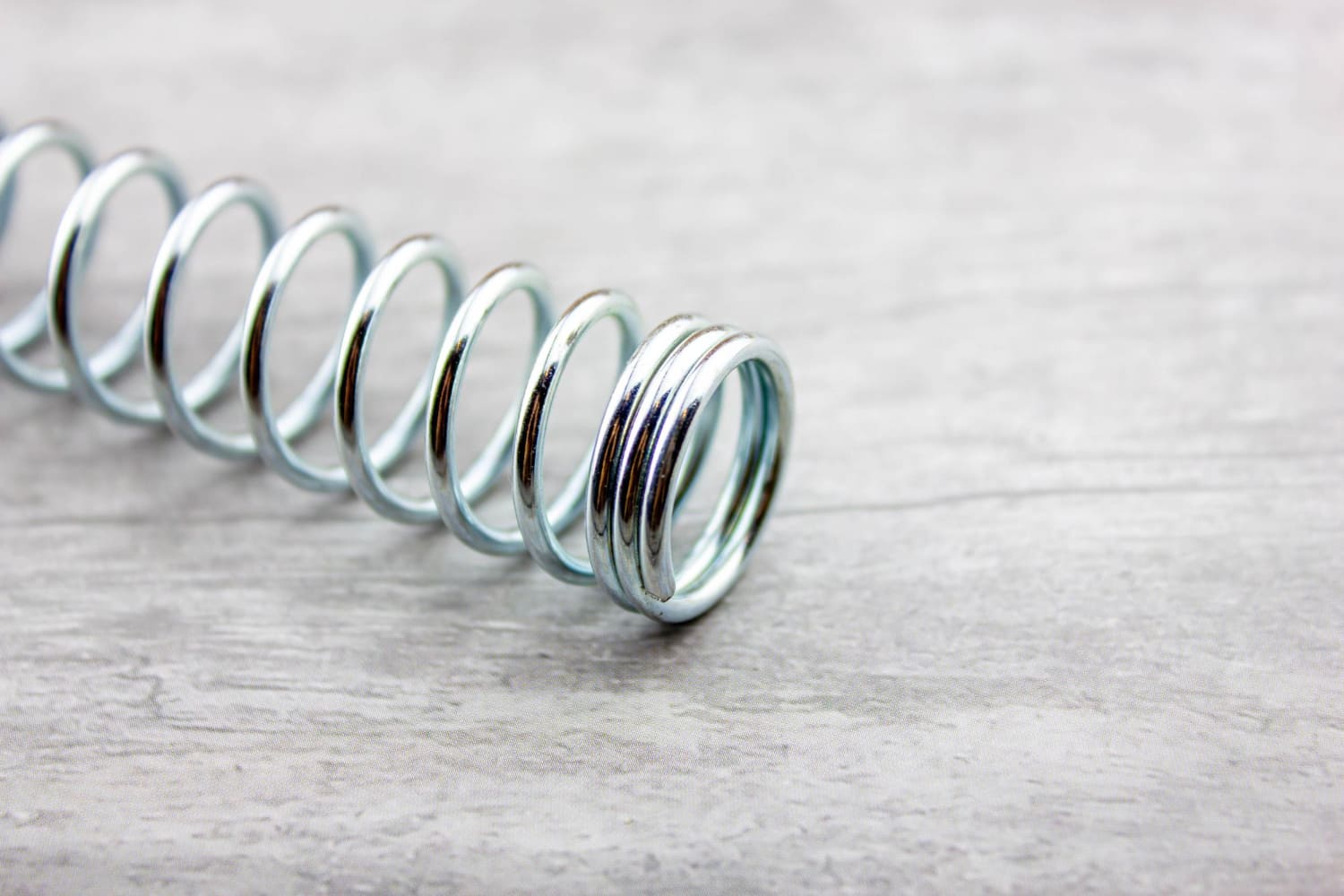
- Cylindrical Springs: This is the most popular type, characterized by a constant outer diameter. We manufacture them from wires with a diameter ranging from 0.2 to 18.5 mm. They act like a "predictable worker"—offering a linear force characteristic, which means the force increase is directly proportional to the deflection. They are economical to produce, but at longer lengths, they require guidance (a mandrel or sleeve) to avoid buckling.
- Conical Springs: Their diameter decreases towards one of the ends. They are "space-saving champions" because they allow for so-called telescoping—during compression, the coils nest within each other. This allows for a very low solid height (even down to twice the wire diameter). They offer progressive stiffness, which is desirable in applications like electrical contacts or batteries.
- Barrel Springs: They have a larger diameter in the middle section and a smaller one at the ends. This geometry eliminates the buckling problem without the use of additional guides. Additionally, barrel springs excel at dampening vibrations and reducing resonance, making them ideal for vehicle suspensions and heavy machinery.
Comparison of Spring Geometry Parameters
| Spring Type | Force Characteristic | Solid Height | Buckling Resistance |
| Cylindrical | Linear | High | Low (requires guiding) |
| Conical | Progressive | Minimal (telescoping) | Medium |
| Barrel | Progressive | Medium | Very high |
FAQ
When can a conical spring replace a cylindrical one? Whenever the installation height is critical or when a progressive force that increases more sharply towards the end of the stroke is needed.
Do barrel springs require special mounting seats? Usually not, but due to the variable diameter, it is worth consulting the seat design to ensure optimal support for the end coils.
What materials work best with progressive geometry? We use high-quality spring wires compliant with REACH and RoHS standards. The selection of a specific alloy depends on the operating temperature and environment (corrosion).
We invite you for a no-obligation technical consultation. Our engineering team will help optimize the spring geometry for your application.Contact the Sales and Logistics Department:
📞 Phone: +48 17 774 5673
Popularne posty

IATF 16949 Quality in Practice. What Does the Automotive Industry Require from a Spring Manufacturer?
Compression Springs from the Manufacturer: Cylindrical, Conical, or Barrel? Selection for Your Application