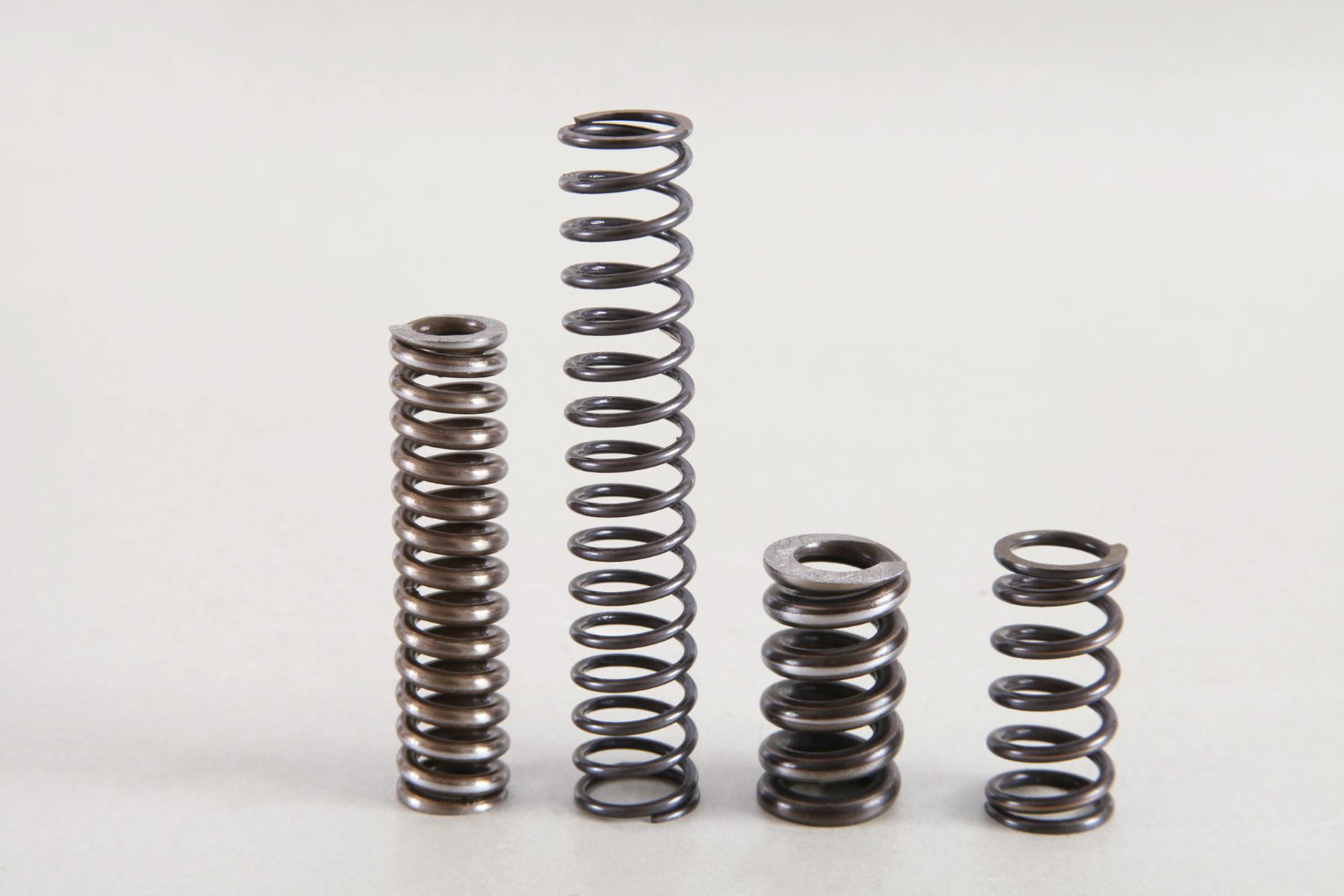
Designing a reliable extension system strictly requires accounting for the initial tension force and hook geometry. An experienced extension spring manufacturer eliminates fatigue risks as early as the design stage. Proper interpretation of the operational physics of these components is key to ensuring the durability of the machinery and equipment where extension springs are utilized.
The Force Hidden in the Coils – How Initial Tension (F0) Works
Initial tension (F0) is an internal force technologically generated during the tight winding of the spring coils, which presses them firmly against each other at rest. For the spring to begin extending at all, the applied external force must first exceed this value.
Using a technical analogy, initial tension can be described as the "entry gate" to the component's operation. Until the external linear force surpasses the F0 value, the coils remain a compact, stationary solid. In this state, the spring behaves like a rigid link rather than a compliant element. Omitting the F0 value from the overall force characteristics of the system is a cardinal design error that distorts the final operating curve of the spring or assembly.
How to Eliminate the Notch Effect: Safe Spring Hook Geometry
The choice of extension spring end configuration determines its resistance to mechanical damage. The transition zone from the spring body to the hook is the area with the highest concentration of torsional and bending stresses (the so-called geometric notch), where fatigue fractures most commonly occur.
| Hook Type | Design Characteristics | Stress Concentration Level / Application |
| German loop (full) | Standard, bent from the last coil to the central axis. | Medium; standard duty-cycle applications, easy assembly. |
| English loop (half) | Raised by half a coil, high hook configuration. | Higher; flexible mounting, lower lateral stiffness. |
| Threaded insert plug | The spring body is conically tapered around a threaded bolt. | No stress concentration in the wire; critical (high-duty) applications. |
FAQ
Can an extension spring be manufactured with zero initial tension?
Yes. By appropriately altering the pitch geometry and winding process parameters on CNC machines, we can achieve loosely spaced coils. Such a spring responds to any external tensile force, no matter how minimal, starting from the zero point.
How does the hook bending radius affect its fatigue life?
The rule is simple: the smaller the bending radius, the greater the stress concentration and the risk of fracture. A safe internal hook bending radius should be at least twice the diameter of the wire used.
When is it beneficial to use swivel hooks instead of fixed ones?
Swivel hooks (e.g., screw-in hooks or loose pin shackles) should be used wherever the anchor point performs pivoting movements or where there is a risk of force misalignment. This eliminates harmful bending and torsional stresses acting on a fixed hook.
Rely on Metalpol's Engineering Support
The correct selection of spring components requires advanced knowledge of metallurgy and strength of materials. As a certified manufacturer (ISO 9001:2015, IATF 16949:2016), we offer comprehensive support from the CAD/CAM design phase to the finished product.
We invite you to contact our Technical and Sales Department in Mielec. Send us your system's operational parameters, and our engineers will verify the strength calculations for your project.